
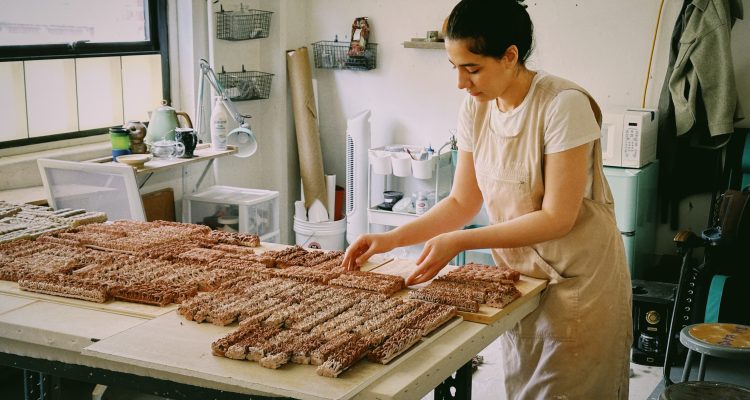
 Grief Resonance, 2023–2024, Egyptian paste (Ceramic), MDF, yarn, 8 x 6 ft x 2.5 in
ArteEast is pleased to present an interview with artist Maedeh Tafvizi as part of our Artist Spotlight series.
Maedeh Tafvizi is an Iranian-born ceramic artist, educator, and material researcher whose work bridges installation, performance, material science, and design. Tafvizi holds an MFA in Ceramics from the Rhode Island School of Design. Her work has been exhibited nationally and internationally, with upcoming presentations at the 2026 Sharjah Islamic Arts Festival and the 2025 Tallinn Design Festival. Past exhibitions include the Bristol Art Museum, ESPASSO Gallery (NYC), SK Gallery (NYC), 12GatesGallery (Philadelphia), and Material Acts (California). She has been featured in Surface Design Journal, invited to speak at Textile Talks, received the European Product Design Award, and was featured on the London International Creative Competition. Tafvizi has taught at Bennington College, co-led advanced ceramics workshops, and managed community studios across New York and New Jersey.
ArteEast: Can you tell us about your overall practice and the main themes you return to within your work?
Maedeh Tafvizi: My practice lives in the space between making and listening. I work primarily with clay, but I don’t treat ceramics as a closed tradition or a set of techniques. For me, it’s a structure for thinking about time, rhythm, and what it means to exist with something unfinished.
Most of my works begin with a feeling I can’t yet explain; something unresolved that needs to be held, not solved. Ceramics give me a space to hold that tension. It’s slow. It resists urgency. It carries memory without turning it into a story. I appreciate that clay doesn’t demand resolution; it allows for doubt, for delay, for care.
A lot of this comes from the way I studied Islamic art during my undergraduate studies. What moved me most wasn’t the surface of things; it was the structure underneath: the hidden symmetries, the logic that didn’t need to speak to be felt. The kind of architecture that guides you through space without telling you where you’re going. The quiet clarity, where depth unfolds over time, and a single form offers something different depending on where you are in your life, has shaped the way I think about repetition, ritual, and return.
The themes present are grief, dislocation, and the weight of what goes unspoken in my work, not as events, but as ongoing conditions. I don’t try to represent them. Instead, I build conditions where they can remain unsettled. My installations, performances, and objects ask for a kind of slowness not out of reverence, but out of respect for what cannot be rushed.
Ceramic makes that kind of space possible. It’s not just a medium I use; it’s a collaborator that sets the pace, holds the tension, and insists that the body stays in the process. That’s the space I trust the most.
AE: You were raised in Isfahan, a city renowned for its art and architecture. How has your upbringing influenced your work as an artist?
MT: Isfahan didn’t just shape my visual memory it shaped how I experience space. From an early age, I moved through environments that didn’t reveal themselves all at once. You had to turn corners, descend steps, shift your body before your eyes could understand where you were. That sense of delay of space unfolding slowly, through movement left a deep impression on me.
I don’t see space as a container. For me, it’s a structure that holds time, attention, and memory. Some spaces ask you to rush. Others make you wait. What I grew up with taught me to value the kind of space that doesn’t declare itself; where rhythm is quiet, where what you see changes depending on where you stand, or how long you stay. That way of moving through architecture taught me more about composition and care than any formal education ever could.
In my work now, especially in installations, I think a lot about what the viewer encounters first, what stays hidden, and what unfolds only through staying close. I’m not interested in spectacle or symmetry. I’m interested in how space can hold uncertainty; how it can slow you down, interrupt you gently, and invite presence without explanation. That kind of spatial logic, layered, unspoken, and alive still forms the core of how I build and where I begin.
AE: Tell us about the materials you currently engage with within your practice and how your approach to materiality has evolved since arriving in the U.S.
MT: Material has always been at the core of how I think, but in the past few years, I’ve become more invested in research-based experimentation especially with recipes and processes that are historically rooted but underused today. I’ve spent a lot of time testing and adapting Egyptian paste, a self-glazing clay body used in ancient Egyptian faience. It’s a delicate material; high in soda and salt, sensitive to humidity and timing but when it works, it does something rare. Its surface emerges from within, not from something applied on top. There’s no division between interior and exterior, and that’s important to me conceptually.
What’s been most exciting is discovering how well this material performs with 3D clay printing. I wasn’t expecting that. But over time, I developed a rhythm that let the paste stay true to its chemistry, even inside a digital tool that usually requires more control. The match has opened up a new kind of collaboration between traditional formulas and contemporary processes not in a symbolic way, but through actual technical compatibility. And that alignment, when it happens, allows the material to do something more complex than either system could alone.
What matters to me is that this research doesn’t stay in the lab; it moves into space. The conceptual outcome of all this testing has been a shift in how I work: I no longer think of material and form as separate from installation or presence. The object isn’t the final step, it’s part of a system of tension, reflection, and suspension. Materials guide my pace, they teach me how to wait, and they determine what kind of intimacy the work can offer. I don’t just study them, I build relationships with them, and through that, the work becomes possible.
AE: Grief Resonance is a significant body of work that you recently completed. What was the impetus and process behind this work? What new possibilities does it open up within your practice?
MT: Grief Resonance began as a deeply personal process. I wasn’t trying to make a loud, monumental statement; it started as a quiet attempt to build a space for my own grief. I was trying to give it form without naming it, to make a space that could hold something I couldn’t fully articulate.
Space has always been central to my practice not just as a container for objects, but as an emotional, bodily, and conceptual condition. I think of space as something that shapes and is shaped by the people who pass through it. In Grief Resonance, that idea took on new urgency.
I started thinking about the rug as a different kind of space one that carries memory, repetition, and architecture at once. A rug isn’t just decor; in Persian homes, it’s the ground you live on, pray on, gather on. I was also obsessively scrolling through Zillow at the time, looking at floor plans and fragmented domestic spaces that felt both intimate and inaccessible. That tension between belonging and absence, memory and blueprint became the core of the project.
From there, the design research began. I worked with 3D printing and Egyptian paste, a fragile, self-glazing clay body that only needs a single firing. I was drawn to its precarity, how it resists control yet preserves detail. I designed modular units that could be assembled like a woven grid, echoing carpet structures while referencing scaffolding and ruins.
The process was a long and iterative testing scale, spacing, surface, and structure. Each crack, warp, and collapse became part of the logic of the piece. I wasn’t interested in perfection. I wanted to ask: what does it mean to make a space that holds grief without fixing it? That doesn’t offer closure, but instead creates room for return?
This project helped me move more firmly into installation, spatial thinking, and research-based practice. It opened up a way of working that allows emotional content, technical exploration, and cultural memory to exist in one system without hierarchy.
I titled the project Grief Resonance after coming across a story from some regions of Iran: when women lose a loved one, they sometimes begin weaving a rug in that person’s memory. I kept thinking about the repetition in that act the way they forced themselves to sit behind the loom, day after day, repeating the same gestures. It wasn’t about producing something decorative. It was about staying with the feeling. Sitting inside their grief. And once the weaving was done, the rug itself became a permanent marker, a physical echo of that person and that loss. That story stayed with me, especially as I neared the end of this piece. It made me realize: this is exactly what I was doing. I wasn’t trying to make a loud memorial or a grand gesture. I was creating a space to sit with my own grief, to give it rhythm, form, and ultimately a structure that could hold it and let it continue resonating.
AE: What and who are some of your major creative influences, and why?
MT: Rather than being shaped by one particular artist or source, I see myself in constant dialogue with spaces, narratives, and traditions that have left a deep imprint on me. Growing up in Isfahan, a city where architecture doesn’t scream but always has something to say made me sensitive to the subtlety of the unspoken. It taught me to value how space can hold meaning without declaring it.
Classical Persian literature has always been part of my body. Its tone, its metaphors, its ability to say and withhold at the same time all of that has shaped the way I see and build. I’ve learned that form always carries meaning, even when it’s quiet, even when it’s incomplete.
Teaching and working in studios have also shaped me profoundly. Sometimes watching a student’s first encounter with clay, or seeing how a piece collapses in the kiln, has offered more to me than visiting an exhibition. Those lived, physical experiences have stayed with me.
And of course, the experience of migration has marked both my mind and body being placed in unfamiliar spaces, building temporary homes again and again, navigating cultural thresholds. All of that becomes part of the world-building I do in my work.
Ultimately, my biggest creative influence is the act of making itself that constant negotiation between idea, material, and body.
AE: What are you currently working on and do you have any shows or projects upcoming in 2025-2026?
MT: The most significant project I’m currently working on is a large-scale installation for the Sharjah Islamic Arts Festival 2026. The piece explores the idea of emotional return, a kind of movement that isn’t geographic, but bodily and psychic. I’m working through repetition, failure, and the physical resistance of ceramic materials to trace the invisible fragments we carry with us.
Another recent piece has been selected for the Tallinn Design Festival 2025 in Estonia. It’s a more minimal and quiet work, but highly textural. I’m exploring how texture and rhythm can act as a sensory language, something that doesn’t require translation, yet still holds presence and meaning.
I’m also showing work in an upcoming group exhibition titled “IRL” at Platform Project Space in DUMBO, Brooklyn, opening in October 2025. The show, organized by the RISD MFA Illustration Class of 2025, explores storytelling and embodied narratives. My contribution continues my interest in fragmentation and unresolved forms as spaces for meaning.
In addition, I’m co-authoring a chapter titled “Claying Curtains and Carpets” for the forthcoming book Claying Architecture: Making Machine and Material Kin (ORO Editions).
Beyond these, I’m developing a few independent projects that allow me to dive deeper into material research. These are slower, more open-ended experiments where I’m testing how ceramics through form, chemistry, and surface can build conceptual and spatial propositions. I’m trying to let the material lead, and see how it can shape a language of its own.
MAEDEH TAFVIZI ONLINE:
Instagram: @maedetafvizi


